
What Is a Certificate of Analysis? How to Review Product Lab Results Online

When purchasing a manufactured product, you may see references to third-party testing or a Certificate of Analysis. But what does a Certificate of Analysis show, and how can you determine whether you are viewing the correct report?
A Certificate of Analysis—commonly called a COA—summarizes the laboratory testing performed on a specific sample or production batch. Learning how to review a COA can help consumers, retailers, and business partners better understand the testing information available for a product.
What Information Is Included on a COA?
The exact format varies by laboratory and product type, but a COA will generally identify:
The product or sample tested
The corresponding batch or lot number
The laboratory that performed the testing
The date the sample was received or tested
The tests performed
The results and units of measurement
Applicable reporting limits or specifications
A pass, fail, or other conclusion when appropriate
Depending on the product and its testing plan, a COA may include results for active-ingredient potency, cannabinoid content, microbial quality, heavy metals, or other applicable characteristics.
Not every COA includes every type of test. The testing performed should be evaluated in relation to the product, its ingredients, its intended use, and the manufacturer’s established specifications.

Why Is the Batch Number Important?
A COA is associated with a particular sample or manufacturing batch—not every product ever made under that product name.
The batch or lot number connects the finished product to its manufacturing and testing records. When reviewing a COA, the batch number printed on the product should match the number shown on the report.
This connection supports traceability and helps ensure that you are reviewing results associated with the product in your possession.
How to Find EarthMed Lab Results Online
EarthMed organizes available COAs by product and batch number. To locate a report:
Find the batch or lot number printed on your EarthMed product.
Visit the EarthMed Lab Results page.
Locate the correct product and strength.
Select the batch number that matches your product.
Review the corresponding laboratory report.
Always begin from the official EarthMed website rather than relying on a report shared through an unfamiliar link. If you cannot locate your batch number or have questions about an available report, contact EarthMed for assistance.
How to Read the Results in a Certificate of Analysis
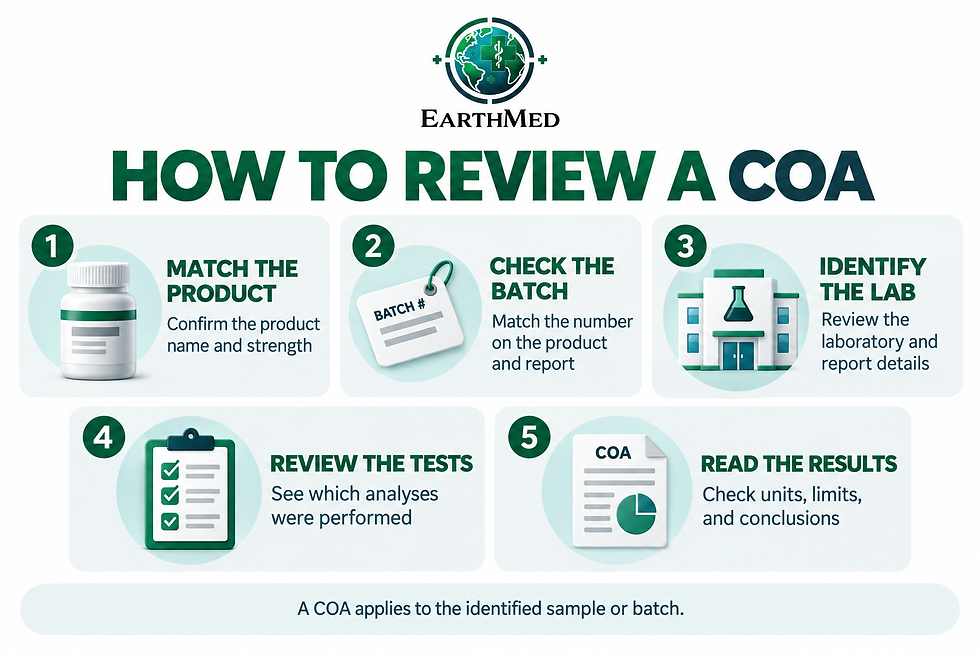
When opening a COA, begin with the identifying information before reviewing the numerical results.
Confirm the product and batch
Verify that the product name, strength, and batch number correspond with the information on your product.
Identify the testing laboratory
The report should identify the laboratory responsible for the analysis. It may also include the laboratory’s address, report number, credentials, or authorized signature.
Review the tests performed
Look at the individual analyses listed on the report. Only draw conclusions about tests that were actually performed. A potency report, for example, should not be treated as confirmation that unrelated microbial or contaminant testing was also completed.
Check the units
Results may be reported using percentages, milligrams per gram, milligrams per unit, colony-forming units, or other measurements. Units are essential to correctly understanding a numerical result.
Look for specifications or conclusions
When specifications are included, compare the reported result with the applicable acceptance limit. A “Pass” result generally means the tested sample met the laboratory or manufacturer’s listed criterion for that particular test.
What a COA Does—and Does Not—Tell You
A COA provides useful information about the sample and tests identified in the report. However, it should be reviewed within its proper scope.
A COA does not necessarily mean:
Every individual unit was independently tested
Every possible contaminant or quality attribute was evaluated
The laboratory approved all product labeling or marketing claims
The report replaces the manufacturer’s overall quality system
The product is appropriate for every individual or intended use
Instead, a COA should be considered one part of a broader quality program that may also include material controls, documented manufacturing procedures, batch records, specifications, in-process checks, finished-product review, and quality-unit oversight.
Why Transparency Matters
Making relevant laboratory reports accessible allows customers and business partners to review testing information associated with individual product batches.
At EarthMed, our manufacturing operations are supported by documented procedures, material controls, batch records, quality oversight, and product testing. Providing online access to available COAs is one way we support product transparency and informed purchasing decisions.
To review available reports, visit the EarthMed Certificate of Analysis Results page and locate the batch number shown on your product.
This article is provided for general educational purposes. Testing requirements and appropriate specifications vary according to the product, ingredients, intended use, and applicable regulatory requirements.
Comments